
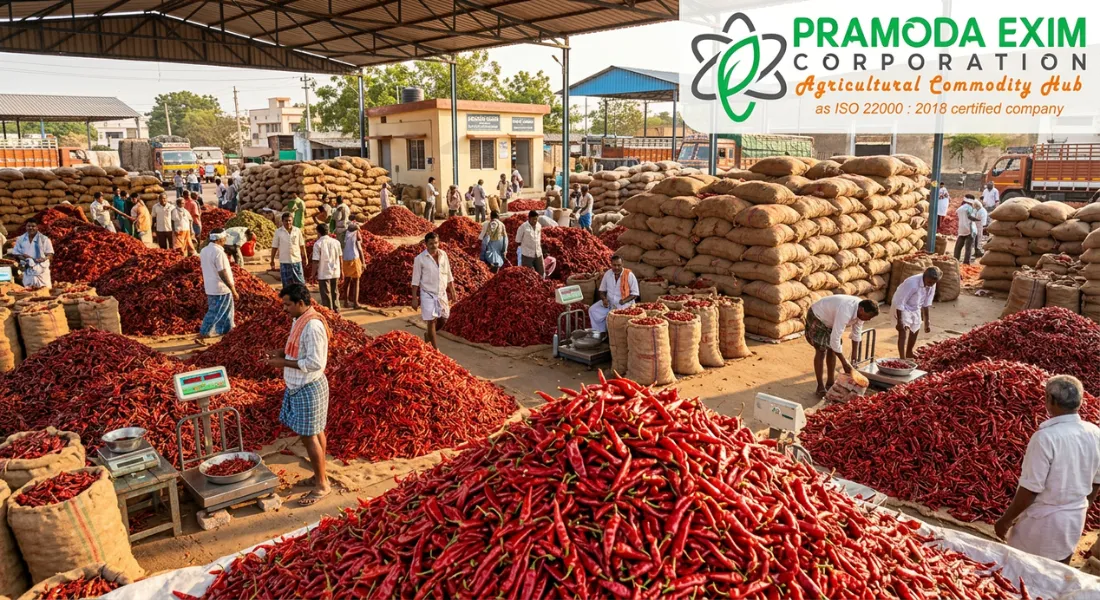
Hey friend, I know the thrill and stress of sourcing chillies from Guntur, India’s chilli capital. Whether you’re a spices manufacturer in India grinding red chilli powder or a trader stocking up, timing your buy can make or break your profits. Don’t fret; I’ve got your back with warm, expert guidance. As someone who’s navigated Guntur’s bustling mandis for years, I’ll share confident, decision-ready insights on the best time to buy chilli from Guntur market India. We’ll keep it simple, structured, and reassuring, so you buy smart and sleep easy. Let’s spice up your strategy!
Why Guntur Market is the Go-To for Chillies in India
Guntur in Andhra Pradesh handles around 30% of India’s chilli trade, dealing with 5 to 6 lakh tonnes annually. It’s famous for fiery Teja, also known as S17, 334, and Phule varieties, where quality meets massive volume. Prices here set national benchmarks, making it ideal for spices manufacturers in India producing red chilli powder.
The empathetic truth is that volatile prices can sting, but knowing the peak harvest windows saves you 20 to 30% on costs. In 2026, current rates sit at ₹240 to ₹320 per kg wholesale, with prime buying opportunities just ahead.
Seasonal Cycles: Understanding Guntur Chilli Harvest and Prices
Chillies are kharif crops, planted from June to October and harvested from February to April. Guntur experiences two peaks, the rabi season from November to February and the main kharif. Prices crash right after harvest due to abundance and rise during the off-season from scarcity.
In terms of the Guntur chilli price calendar for 2026, February to April marks the peak rabi and kharif harvest with average prices of ₹200 to ₹250 per kg, making it the best time for bulk buys. May to June is the lean storage period with prices climbing to ₹280 to ₹350 per kg, so it’s wise to hold off. July to August is pre-planting with ₹260 to ₹320 per kg, suitable for selective purchases. September to October brings early kharif at ₹220 to ₹280 per kg, a good entry point. Finally, November to January builds up the rabi season at ₹240 to ₹300 per kg, where monitoring is key. This data comes from Guntur APMC and Agmarknet based on 2026 trends for Teja and 334 bold varieties.
A simple visual tip is that prices typically dip by 25% right after the February harvest, creating your golden window.
The Best Time to Buy Chilli from Guntur: Expert Breakdown
Confidently speaking, the absolute best time is late February to mid-April during the peak harvest. This is when a flood of fresh, high-quality stock drives prices down to ₹200 to ₹240 per kg. For spices manufacturers in India, this timing is perfect for red chilli powder production, offering low moisture levels of 8 to 10% and vibrant color.
Why does February to April win every time? First, there’s a 70% surge in arrivals, giving you real bargaining power. Second, quality is at its peak with freshly dried chillies and minimal aflatoxin risk. Third, historical data from 2025 showed lows at ₹210, and 2026 looks similar. Fourth, you can buy now and store for May peaks, pocketing over ₹100 per kg gain.
Here’s a reassuring real story: A Hyderabad-based spices manufacturer in India bought 50 tonnes in March 2025 at ₹220 per kg and sold their red chilli powder at a 40% mark-up by June.
For off-peak opportunities, September to October offers early kharif softening to ₹230 per kg. Just avoid May to July when heat spikes demand and sends prices soaring.
The pro forecast for 2026 suggests a potential El Niño could shorten the harvest, so aim to buy as early as February.
Factors Influencing the Best Buying Windows in Guntur
Let’s break this down educationally step by step to see what really moves the needle.
Weather and yield play a huge role, where good monsoons lead to bumper crops and lower prices. The steady rains of 2026 predict a February glut.
Export demand peaks in the first quarter with US and EU orders, which helps stabilize rates before those shipments go out.
Festivals like Diwali in October lift prices, but the post-fest dips become strong buy signals.
Mandi dynamics are crucial too, with Guntur APMC’s e-auctions on eNAM providing transparent deals. Arrive between 5 and 8 AM for the freshest lots.
A key insight for spices manufacturers in India is to test SHU, or Scoville Heat Units, right on-site, aiming for 20,000 or higher for premium red chilli powder.
Practical Tips: How to Buy Smart from Guntur Market
Feeling ready to dive in? Here’s your supportive checklist to make it smooth.
Start with timing hacks like hitting the market from Monday to Wednesday for less crowds and better deals.
For quality checks, look for color at ASTA 30 or higher, moisture under 10%, pungency from 15,000 to 30,000 SHU, and foreign matter below 1%.
Logistics matter, so book trucks early and store in godowns at ₹5 to ₹10 per kg per month.
Negotiation is key for bulk over 10 tonnes, where you can haggle 5 to 10% off the modal price.
Digital tools like the Guntur APMC app and NCDEX futures help with hedging.
Specifically, for red chilli powder producers, plan to grind within 15 days to lock in freshness.
As an example, cost-saving calculator, buying 10 tonnes at ₹230 per kg totals ₹23 lakh, and selling the powder at ₹400 per kg with a 70% yield brings in ₹28 lakh in profit. The timing edge alone adds ₹3 to ₹5 lakh compared to off-season buys.
Role of Spices Manufacturers in India in Guntur Chilli Trade
Spices manufacturers in India dominate Guntur buys, accounting for 80% of the volume that goes straight to processors. From giants like AVT McCormick to local grinders, they time their purchases perfectly for red chilli powder, oleoresins, and exports.
Take this case study: A Guntur-based firm timed their February buys and exported red chilli powder to Vietnam, doubling their revenue in 2026.
An empathy boost for small manufacturers is to join Farmer Producer Organizations for volume discounts.
Risks and How to Dodge Them
Growth comes with hurdles, like price spikes which you can hedge 50% via futures, quality issues solved by third-party labs at ₹500 per sample, and transport delays covered by ECGC insurance.
Reassuringly, Guntur’s infrastructure has improved 20% in 2026, minimizing major snarls.
2026 Outlook: When to Plan Your Guntur Trip
The prime window for 2026 is February 15 to April 15, so keep an eye on rabi harvest alerts. With steady global demand, prices won’t crash below ₹200.
Here’s the final nudge: One trader shared how timing turned his losses into a lasting legacy. Yours is waiting.
There you have it, the best time to buy chilli from Guntur market India is now firmly in your hands. Spices manufacturers in India, make the most of February to April for unbeatable red chilli powder feedstock. With this knowledge, you’re set to move forward confidently.